One Fine Spring Day (2001) Overview: The Seasons of Love
- Director: Hur Jin-ho
- Cast: Yoo Ji-tae (Sang-woo), Lee Young-ae (Eun-su)
- Genre: Melodrama, Drama
- Release Year: 2001
Synopsis: Sang-woo, a sound engineer, and Eun-su, a radio producer, meet while recording nature sounds. Their relationship begins in the crisp air of late winter and peaks during a lush spring. However, as the seasons shift, the One Fine Spring Day (2001) narrative follows the painful reality that love is not a permanent state, but a changing climate.
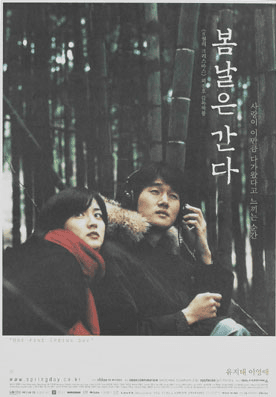
The Emotional Philosophy of One Fine Spring Day (2001)
There are films that tell you love is beautiful, and there are films that quietly show you love is temporary. This romantic drama from 2001 belongs to the second category. It does not dramatize romance; it observes its disappearance.
The Entropy of Emotion in Hur Jin-ho’s World
The title carries the entire philosophy of the film. Spring does not last; it appears, peaks, and disappears without an apology. This film begins at a point of emotional certainty already moving toward uncertainty. In this landscape, the characters are not masters of their fate; they are subjects of the seasons. We don’t choose when the snow melts; we simply find ourselves standing in the damp aftermath..
Socio-Cultural Background: The IMF Crisis in One Fine Spring Day (2001)
To understand the profound resonance of One Fine Spring Day (2001), we must look at the scars on the Korean psyche after the 1997 IMF financial crisis. This event did more than damage the economy; it destroyed the national illusion of “permanence.”
The Death of Lifelong Stability
Before the crisis, relationships were viewed through the lens of “Jeong” (eternal bonds) and lifelong stability. Post-IMF, a sense of “Emotional Pragmatism” emerged. People became emotionally cautious. Relationships became fragile, and emotional investment became riskier.
- Sang-woo: The Analog Idealist: Sang-woo represents the pre-crisis world—the naive belief that love remains static if you just record it carefully enough.
- Eun-su: The Post-Crisis Survivor: Eun-su, a divorcee, represents the reality of the new era—independent, wary, and understood that everything can be taken away in an instant.
Personal Echoes: Indifference as a Survival Skill
I remember talking to friends in Gangneung about this film when it first came out. We didn’t talk about the plot. We talked about how “scary” Eun-su was—not because she was cruel, but because she was indifferent. In the post-IMF Korea, heartbreak was a luxury that required time and energy; indifference was a necessary survival skill.
One Fine Spring Day (2001) reflects this psychological shift with extraordinary subtlety. Earlier Korean cinema often portrayed shared suffering. But this film moves inward. Emotion becomes private and unspoken. The camera does not externalize emotion; it listens to it disappearing. This shift from collective passion to individual isolation is the defining characteristic of modern Korean emotional realism.
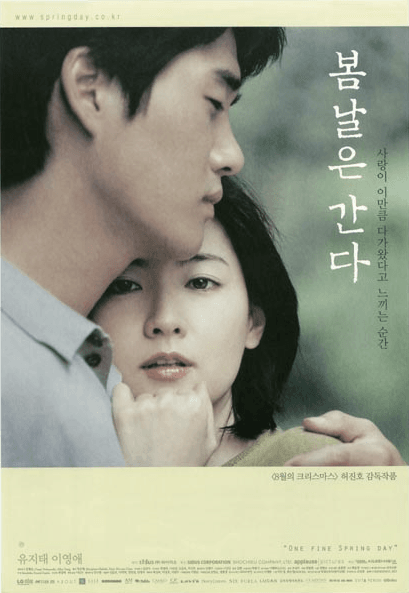
Sound Design and the Philosophy of the After-sound (잔향)
Sang-woo is a sound engineer, which is a structural design rather than a symbolic decoration. He listens for a living: wind, trees, and environmental noise. But the most important sound he cannot hear is the internal emotional change within Eun-su.
Foley as Dialogue in One Fine Spring Day (2001)
The genius of Hur Jin-ho lies in his realization that human voices often lie, but the world around them does not.
- The Bamboo Forest: The “rustle” of the bamboo leaves represents the chaotic, unpredictable friction of early romance.
- The Temple Bell: The bell has a decay—a long, vibrating tail of sound. This is the structural metaphor for the entire film: the “After-sound” (잔향). Love, in this film, is the vibration that lingers long after the actual strike has ended.
Analog Loss: Taping Over a Shared Past
In 2001, recording a new sound over an old one didn’t just erase the previous voice—it replaced it. One Fine Spring Day (2001) argues that memories are magnetic tapes that degrade every time we play them back. It doesn’t leave a clean slate; it leaves behind a messy, degraded echo. What is lost is not the memory itself, but the certainty that it once existed.
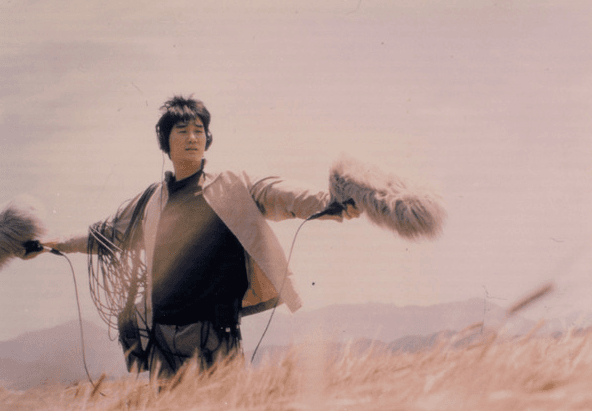
The Visual Style of One Fine Spring Day (2001): Restraint and Space
Director Hur Jin-ho rejected the “Shinpa” style (extreme emotional manipulation) of 1990s cinema in favor of a “minimalist” approach.
Static Camera and Negative Space
The camera in One Fine Spring Day (2001) does not chase emotion; it observes it. Hur uses wide shots and long takes, keeping the camera at a distance. The beauty lies in the “Negative Space”—the words characters leave unsaid during their long walks together.
The Psychology of Eun-su’s “Quiet Exit”
Eun-su is often viewed as a villain, but she represents the early cinematic portrayal of “Emotional Burnout.” Her “quiet exit” is a form of self-preservation. The “human smell” of this film comes from the uncomfortable truth that sometimes we stop loving someone simply because we no longer have the energy to sustain the relationship.
Character Study: Realism over Romance
Sang-woo: Clarity Outside, Confusion Inside
Sang-woo is emotionally observant but personally unclear. He understands external sound but fails to understand his own emotional shift, recognizing change only when it is too late. He asks, “How can love change?” with a naivety that is almost painful to witness.
Eun-su: The Power of Emotional Autonomy
Eun-su avoids emotional dependency and resists permanence. Audiences often misunderstand the casual “Ramyeon” phrase as symbolic romance. But in the context of One Fine Spring Day (2001), it represents emotional simplification. She asks, “Do you want to eat ramyun?” because she doesn’t want to talk about “us.” It is a tactical retreat into the ordinary to avoid the weight of a formal relationship.
The Scent of 2001: A Sensory Archive of Emotional Humidity
To truly understand One Fine Spring Day (2001), one must look past the screen and into the very texture of the air it captures. Looking back from 2026, the film feels like a time capsule of a specific “Korean humidity.”
I remember the year 2001 clearly. It was a time when the world was vibrating with a strange, low-frequency anxiety. We were living in the gap between the analog past and the high-speed digital future. In the film, when Eun-su brushes her damp hair after a shower, or when the characters sit on a small sofa in a cramped, unconditioned room, you can almost feel the stickiness of the air. This “sensory weight” is the foundation of Hur Jin-ho’s realism. It is not the sterilized, high-definition summer we see in modern dramas. It is a summer of mosquitoes, the constant, rhythmic hum of an old floor fan, and the smell of cooling asphalt after a sudden rain.
This sensory precision is why the film resonates with “human smell.” It doesn’t present love as a glossy poster; it presents it as a physical experience—something that has a scent, a temperature, and a weight. When the relationship begins to rot, you don’t just see it; you feel the air in the room get thinner and colder.
The Archetype of the “Analog Man”: Sang-woo’s Tragic Preservation
Sang-woo’s profession as a sound engineer in One Fine Spring Day (2001) is the film’s most tragic metaphor. He is a man who believes that careful listening and the right equipment can archive a moment forever. In his eyes, love is a meticulous recording session where every rustle of bamboo and every soft breath from the woman he loves must be captured and preserved.
He treats love like a recording session. He wants to capture the rustle of the bamboo, the sound of the temple bell, and the soft breathing of the woman he loves. But life, unlike a magnetic tape, cannot be paused or rewound. In one scene, Sang-woo listens back to a recording of Eun-su’s voice. The tape captures the sound, but it cannot capture the intent that has already changed.
This is the central tragedy of the “Analog Man.” He lives in a world of preservation, while the world he is in—represented by Eun-su—lives in a world of constant, fluid transition. His naivety isn’t just about love; it’s about his refusal to accept that time is a destructive force. Every time he plays that tape, the magnetic particles degrade. Every time he revisits the memory, the truth of it becomes a little more distorted. He isn’t just losing a girlfriend; he is losing his faith in the permanence of the world.
The Symbolism of “Ramyun” in One Fine Spring Day (2001)
We must talk about the “Ramyun” line again, but from a psychological perspective. In One Fine Spring Day (2001), Eun-su’s invitation to eat ramyun is a masterpiece of emotional defense.
Why ramyun? Because ramyun is functional. amyun is fast. It is cheap. More importantly, it represents a meal requiring zero emotional investment from a woman who has already exhausted her romantic capital. By inviting Sang-woo to share a pot of noodles, Eun-su is setting the “price” of their intimacy. She is saying, “We can share this physical space, but we are not building a future.”
Many male audiences in 2001 found this cold. But if you look at it through the lens of a woman who has already survived a failed marriage (a social stigma in Korea at the time), it is a brilliant strategy. She is avoiding “Emotional Labor.” She doesn’t want the heavy, multi-course meal of a traditional Korean commitment. She wants the instant, digestible, and easily disposable connection of a spring day. The tragedy of One Fine Spring Day (2001) is that Sang-woo treated the ramyun like a sacred feast, while for Eun-su, it was always just a quick snack before moving on.
The Foley of Silence: Listening to What Is Not There
One of the most human elements of One Fine Spring Day (2001) is the use of “Empty Sound.” In many scenes, Hur Jin-ho leaves the microphones open to the environment. We hear the background noise of a distant highway, the wind in the power lines, or the sound of water dripping in a sink.
This creates a “Living Silence.” It reminds the audience that the world continues to move even when the characters are frozen in their grief. In the final third of the film, the dialogue drops away almost entirely. We are left with the “Foley of Loneliness”—the sound of footsteps on gravel, the sliding of a door, the rustle of a jacket.
These sounds carry more weight than any dramatic monologue. They remind us that the most profound moments of our lives are often the quietest. When Sang-woo stands alone in the snow at the end, the sound of the wind isn’t just a sound; it’s the voice of his own acceptance. He is finally listening to the silence, rather than trying to fill it with a recording of a past that no longer exists.
The Geography of Intimacy: Gangneung vs. Seoul
The physical distance between Sang-woo’s life in Seoul and Eun-su’s life in Gangneung serves as a physical manifestation of their emotional disconnect.
Seoul represents the heavy, traditional, and family-oriented past (Sang-woo living with his father and grandmother). Gangneung, a coastal city, represents the fluid, temporary, and shifting nature of the ocean. Their relationship is a series of long drives across the mountains—a constant effort to bridge two incompatible worlds.
In One Fine Spring Day (2001), the car becomes a third character. It is a confined space where they are forced to be intimate, yet the road ahead is always leading them away from one another. The exhaustion of these drives mirrors the exhaustion of their emotional negotiation. Eventually, the mountain passes become too high, the distance too far, and the car runs out of fuel. The geography of the film tells us what the characters cannot: that some distances are simply meant to stay wide.
Beyond Jeong: The Slow Drain of Affection
Korean culture defines ‘Jeong’ (정) as a sticky, invisible bond. However, One Fine Spring Day (2001) provides a chillingly honest look at what happens when ‘Jeong’ begins to leak out. It is not a sudden rupture; it is a slow drain.
Early in the film, a comfortable, shared silence fills the space between them. But as the season turns, that silence begins to change. It no longer feels shared; it becomes an exhausting vacuum. Affection doesn’t just disappear; it turns into a burden. Jeong does not simply disappear; rather, it loses the emotional mass necessary to keep two individuals anchored to one another.
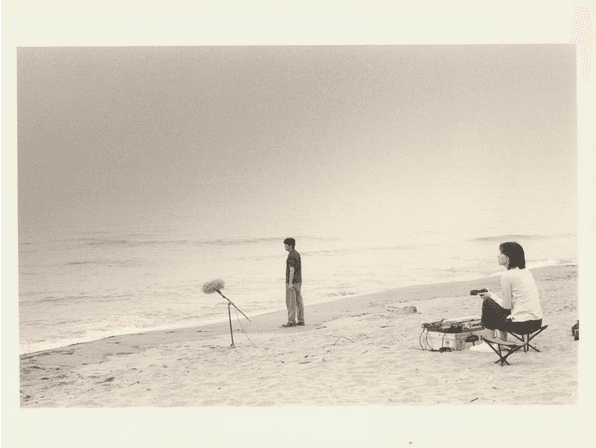
Why One Fine Spring Day (2001) Still Matters in 2026
In 2026, One Fine Spring Day (2001) has become a shared emotional language for audiences across cultures.
- From Analog to Digital: While 2001’s distance was physical (silent phone calls, long drives), today’s distance is invisible—occurring through unread messages and digital exits. The emotional structure behind today’s “connected” yet isolated relationships is more accurately reflected here than in many contemporary works.
- The Global Wave: It stands alongside global masterpieces like Past Lives that value observation over explanation. It proved that Korean storytelling achieves universality not through spectacle, but through the quiet, precise examination of the human heart.
Final Reflection: The After-Sound of One Fine Spring Day (2001)
One Fine Spring Day (2001) does not end with a resolution; it ends with a breath. What remains on screen is not reconciliation, but a hard-won clarity—the understanding that we cannot “solve” certain emotional experiences; we can only live through them.
The final emotional truth lies in the quiet dignity of letting go. Spring is never a promise of permanence; it is a transition. To watch Sang-woo in the final scene—smiling faintly while recording the sound of the wind alone—is to witness the birth of a more mature version of love. It is a love that finds contentment simply in having existed.
Related Articles
- 10 Best Korean Movies – Must-watch masterpieces of Korean cinema.
- Parasite Review – Hidden symbols and social commentary explained
- 90s Korean Movie Culture – The creative revolution that started Hallyu
- The Unique Storytelling Style of Korean Films: – 5 narrative techniques that define Korean cinema
Source: Basic film information from Korean Movie Database (KMDb)