Exploring the profound Buddhist Philosophy behind Kim Ki-duk’s masterpiece, Spring, Summer, Fall, Winter… and Spring (2003), reveals a story that stays with you forever—quietly, almost like a memory you didn’t know you had.
Directed by the visionary Kim Ki-duk, this story doesn’t rush. It doesn’t rely on loud speeches or fast action. Instead, it invites you to sit by a quiet lake and watch as a life unfolds. This is more than a movie; it is a profound meditation on Buddhist Philosophy that speaks to the soul through silence and the changing seasons.
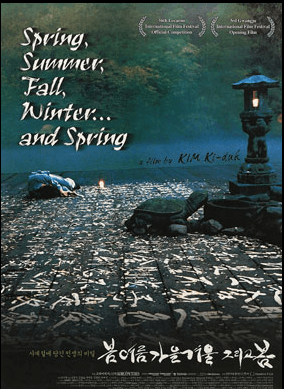
Introduction to Buddhist Philosophy in Kim Ki-duk’s Masterpiece
ISouth Korean cinema experienced a radical transformation during the early 2000s. This period favored visceral thrillers, but Kim Ki-duk looked toward the timeless cycles of Buddhist Philosophy. Amidst this cinematic roar, Kim Ki-duk—a director previously known for his confrontational and provocative narratives—surprised the world with a profound, breathing “silence.”
The directorial intent behind Spring, Summer, Fall, Winter… and Spring was to reclaim the space between words. Kim recognized that in our pursuit of meaning, we often clutter our lives with unnecessary noise. By choosing a floating temple as his stage, he created a “Visual Sermon” where the sound of a rowing oar or the rustle of wind through ancient pines speaks louder than any script. This was not just a stylistic choice; This film demonstrates that we find profound human truths in stillness. Through the lens of Buddhist Philosophy, it shows that guilt, love, and enlightenment await us in the quiet moments we often fear.
A Story That Moves Like the Seasons: A Masterpiece of Stillness
Beyond the Screen: The Sensory Hum of Existence
When you first sit down to watch Spring, Summer, Fall, Winter… and Spring, the first thing you notice is not the plot, but the air. There is a specific “humidity” to the film that you can almost feel on your skin. As a viewer, you do not just watch a story; the film submerges you into the depths of the Jusanji Reservoir.
This immersive experience reflects the fluid and ever-changing nature of Buddhist Philosophy, where the water acts as a mirror for the soul. I remember the distinct sound of the wooden boat creaking against the water—a lonely, rhythmic groan that seems to echo the protagonist’s own internal struggle.
The Sensory Humidity: Feeling the Atmosphere of Jusanji
In an era where movies fight for our attention with explosive CGI, Kim Ki-duk asks us to observe the moss on a stone or the mist clinging to willow trees. This isn’t just cinematography; it is a test of our own patience.
We must ask ourselves: Why does silence make us uncomfortable? Why does a lack of dialogue breed restlessness? By confronting these questions, the film becomes a mirror. It strips away modern distractions and reveals how digital noise has silenced the language of nature.
Beyond Digital Noise: The Test of Silence
Through this clarity, we rediscover the essential harmony at the heart of Buddhist Philosophy. This sensory immersion provides the “human smell” that AI can never replicate—the visceral ability to feel the winter ice through a screen.
At first glance, the premise is simple. A boy grows up in a small floating temple on Jusanji Reservoir, guided by an old master. But as we watch him leave, struggle, and eventually return, we realize this isn’t just a story about a monk. The film functions as a mirror, reflecting our own lives back to us through the lens of Buddhist Philosophy.
The Eternal Circle: Life Through the Lens of Buddhist Philosophy
In Buddhist Philosophy, life is not a straight line leading to a destination. It is a circle—a cycle of desire, regret, learning, and starting over. The seasons of the film perfectly map this human journey.
- Spring: The Weight of Innocence – A child ties stones to animals out of curiosity. He doesn’t mean any harm, but the master teaches him a haunting lesson: even our thoughtless actions become a weight we must eventually carry. This is the quiet beginning of Karma.
Our internal commitment, rather than external walls, upholds our morality and mirrors the spiritual discipline of Buddhist Philosophy. Although the waters of Jusanji Reservoir no longer hold the physical temple set today, this void embodies a core tenet of the faith: Impermanence (Anicca).
It reminds us that while life holds many mistakes, the constant, quiet possibility of renewal defines our journey. We must live this truth. As Buddhist Philosophy teaches, understanding alone is not enough; we must embody the path through our own presence.
Spring: The Weight of Innocence – A child ties stones to animals out of curiosity. He doesn’t mean any harm, but the master teaches him a haunting lesson: even our thoughtless actions become a weight we must eventually carry in our hearts. This is the quiet beginning of Karma.
The Weight of Existence: Visualizing the Invisible Burden of Karma
One of the most human elements of this film is its refusal to offer easy judgment. When the young boy ties stones to a fish, a frog, and a snake, he isn’t acting out of malice, but out of a raw, unrefined curiosity. This is the “Human Smell” of the film—it recognizes that we often cause pain before we understand the weight of our own actions.
The old Master’s lesson—”If any of those animals are dead, you will carry a stone in your heart for the rest of your life”—is a masterpiece of psychological metaphor. While scholars often discuss Karma as an abstract debt, this film transforms Buddhist Philosophy into a tangible, physical weight. We all have “stones” in our hearts—mistakes from our youth or words we can never take back. The film suggests that redemption is not the magical removal of these stones, but the grueling, lifelong journey of learning how to carry them with grace until we reach our own “Winter” of reflection.
Summer: The Turbulence of Desire – As adolescence arrives, a young woman visits the temple. With her comes a restlessness. We witness how easily attachment shatters peace, a central warning found within the heart of Buddhist Philosophy
Fall: Remorse and the Concept of Jeong (정) – The monk returns as a man carrying heavy guilt. Here, we see Jeong—that deep, often painful bond formed through shared suffering and the long road to forgiveness.
The Bitter Sweetness of Jeong (정): A Bond That Outlasts Sin
In the “Fall” segment, the Master’s interaction with the returning monk embodies something uniquely Korean: Jeong. This profound attachment serves as a visceral bridge to the compassionate side of Buddhist Philosophy.
To the Western eye, the Master’s treatment of his disciple might seem harsh or distant. But in the Korean soul, Jeong is a thick, sticky attachment that doesn’t break even when someone fails.
The Master doesn’t offer a hug or a verbal pardon. Instead, he gives the man a grueling task: carving the Heart Sutra into the wooden deck with a cat’s tail brush. This is Jeong in its most profound form—it is the act of staying with someone through their darkest “Han” (suffering and resentment) and giving them a path back to themselves. The man’s anger, his frantic carving, and the eventual exhaustion are all stages of a spiritual detoxification. By understanding this cultural nuance, we see that the film isn’t just about Buddhism; it is about the resilient, sometimes painful, but always enduring bond between people who have shared a life, no matter how broken that life has become.
Winter: The Path to Redemption – Against a frozen, silent landscape, the protagonist finds no escape. Without distractions or excuses, he must face only himself, embodying the rigorous self-honesty required in Buddhist Philosophy.
Spring Again: The Eternal Return – A new child arrives. The temple remains. The next generation will learn these lessons again, ensuring that the timeless wisdom of Buddhist Philosophy continues its eternal cycle. It’s a beautiful, bittersweet reminder that life is an endless circle of renewal.
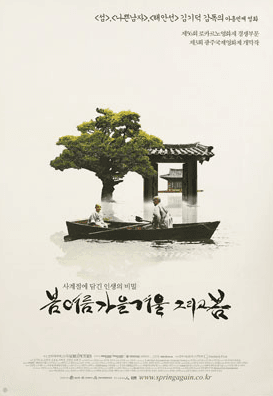
What Does This Film Really Mean?
At its core, Spring, Summer, Fall, Winter… and Spring is about the cyclical nature of human life.
Rather than telling a conventional story, the film reflects a key idea in Buddhist philosophy: life is not a straight path, but a continuous cycle of desire, suffering, reflection, and renewal.
Each season represents a stage of life—innocence, passion, consequence, and transformation.
This is why the film feels so personal. It doesn’t just tell a story; it reflects a pattern we all go through.
Jusanji Reservoir: The Landscape of Buddhist Philosophy
The mystical atmosphere of the film isn’t a special effect—it’s a real place in South Korea. Jusanji Reservoir, located in Cheongsong, is a site where time seems to stand still. Built in 1720, this lake is famous for its centuries-old willow trees that grow directly out of the water.
The Reservoir as a Silent Witness: The Mirror of the Mind
The Jusanji Reservoir is not just a setting; it is a spiritual mirror. Throughout the four seasons, the water changes its texture—from the shimmering clarity of spring to the suffocating ice of winter.
In many scenes, the camera lingers on the reflection of the temple in the water, often making it difficult to tell which is the reality and which is the image. This intentional blurriness reflects a core tenant of Buddhist Philosophy: our perception of the world is often an illusion, a mere reflection of our internal state.
Reconnecting with the Primal Truth of Nature
When the protagonist is in turmoil, the water feels cold and vast, an abyss that threatens to swallow him. When he finds peace, the lake becomes a sanctuary of stillness. This relationship between the human soul and the natural world represents the “human smell” of the narrative.
It reminds us that we are not separate from nature; we are the lake. Our emotions form the ripples, and our wisdom creates the depth beneath. This profound connection sits at the heart of Buddhist Philosophy. In our modern, paved-over lives, we have lost this bond. Returning to this film allows us to re-submerge ourselves in the primal truth of our own reflection.
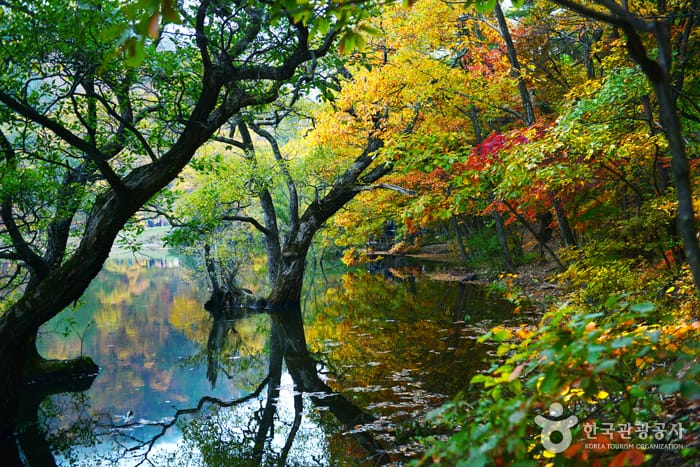
Metaphors of the Submerged: Rooted in Impermanence
The weathered trunks of these trees, submerged yet reaching for the sky, serve as a powerful metaphor for human existence—rooted in suffering, yet striving for something higher. Although the waters of Jusanji Reservoir no longer hold the physical temple, this void embodies a core tenet of Buddhist Philosophy: Impermanence (Anicca). It reminds us that all things eventually return to nature, leaving only the spiritual resonance behind.
📍 Visiting Jusanji Reservoir
- Address: Jusanji-ri, Cheongsong-gun, Gyeongsangbuk-do (경상북도 청송군 주왕산면 주산지리)
- Inquiries: +82-54-870-6111 / 1330 Travel Hotline
- Pro-tip: Visit in the early morning to see the mist on the water, just as it appeared in the film.
The Architecture of the Soul: The Floating Temple and the Door Without Walls
The floating temple on Jusanji Reservoir is a character in its own right. Built specifically for the film and dismantled shortly after, its literal “impermanence” echoes the Buddhist concept of Anicca. But the most striking architectural detail is the door that stands without walls.
Why do the monks walk through a door frame when there is nothing stopping them from walking around it? This is a profound commentary on human discipline and the self-imposed boundaries of our lives. The film suggests that internal commitment, rather than external walls, shapes our morality and our path to enlightenment. This deep personal accountability stands at the core of Buddhist Philosophy. This minimalist production design forces the viewer to confront a haunting question: What invisible doors are you walking through every day? By stripping away the walls, Kim Ki-duk reveals that the only true boundaries are the ones we create in our minds.
The Threshold of the Spirit: Why Doors Exist Without Walls
One of the most hauntingly beautiful images in the film is the freestanding door on the floating temple. In a world defined by open water and endless sky, these doors seem functionally useless, yet the characters treat them with absolute reverence. This is a profound human observation: we live by the rituals we create. For the young monk, walking through the door is an act of discipline; for the visitor, it is an act of entry into a sacred space.
As a viewer, I find this to be a powerful metaphor for our internal lives. We often feel trapped by “walls” that do not exist—social expectations, self-doubt, or past traumas. Conversely, we sometimes ignore the “doors” that are wide open right in front of us. The film suggests that true freedom isn’t the absence of boundaries, but the conscious choice of which thresholds to cross. The absence of walls allows the director to reveal the true source of our values. Our internal commitment, rather than architecture, upholds our morality and mirrors the spiritual discipline of Buddhist Philosophy.
The Global Impact of Korean Buddhist Philosophy
Upon its release, the film was a massive critical success, winning the Grand Prix at the Locarno International Film Festival and maintaining a high score on Rotten Tomatoes. But its true legacy isn’t in awards.
Beyond Orientalism: Why a Silent Korean Film Conquered the Global Heart
Upon its release, Spring, Summer, Fall, Winter… Spring achieved a rare feat: Western critics embraced the film not as an “exotic” curiosity, but as a universal document of the human condition. This global recognition reflects the timeless and inclusive nature of Buddhist Philosophy. While many films about Eastern philosophy fall into the trap of “Orientalism,” Kim Ki-duk’s masterpiece felt grounded in a reality that anyone, regardless of faith, could recognize.
Critics like Roger Ebert hailed the film because it offered an antidote to the “fast-food” editing and sensory overload of Hollywood. It proved that a story about a man in a wooden boat could resonate more deeply than a high-budget spectacle. Historically, this film bridged the gap between Korean cinema and the global “Slow Cinema” movement, showing that the “Korean Soul”—with its unique blend of Jeong (deep attachment) and resilience—had something vital to say to a modern world that had forgotten how to be still.
It matters because it reminds us to slow down. In a world of constant noise, Kim Ki-duk used silence to prove that the most profound emotions—guilt, love, and enlightenment—don’t need words. It is a “visual sermon” that reconnects us with the timeless serenity found in the Korean soul.
Digital Noise and the Search for a Floating Temple in 2026
Why does a film made over twenty years ago resonate even more strongly in 2026? We live in a world of “instant redemption” and “cancel culture,” where digital platforms archive mistakes forever and society rarely offers forgiveness. In contrast, Buddhist Philosophy teaches us the path of internal accountability and gradual transformation. Kim Ki-duk’s masterpiece offers a different timeline. It tells us that transformation takes seasons—not seconds.
We are all, in some way, trying to find our own Jusanji. The relentless pace of digital connectivity exhausts us, while the pressure for immediate success weighs heavily on our souls. In response, Buddhist Philosophy offers a much-needed sanctuary of stillness and gradual growth.
This film acts as a permission slip to be imperfect. It tells us that it’s okay to be the boy who tied the stone, the youth who ran away for love, and the man who returned in shame.
The “Spring Again” at the end isn’t just a plot twist; it’s a promise of continuity. It suggests that while the world outside the reservoir changes with technology and politics, the human heart remains a landscape of seasons.
We return to this film because we need a reminder that our lives follow a larger, quieter cycle. This realization connects us to the heart of Buddhist Philosophy, where every season of life holds its own sacred purpose. It is a sacred rhythm that the internet cannot touch, rooted deeply in Buddhist Philosophy.
The Slow Grind of Redemption: Why Time is the Only Healer
In an age of “instant everything,” this film is a painful, necessary reminder that spiritual growth cannot be downloaded. We must live this truth. As Buddhist Philosophy teaches, understanding alone is not enough; we must embody the path through our own actions and presence.
The transition between the seasons—the agonizing wait for the ice to melt or the leaves to fall—mirrors the slow process of human maturity. The Master doesn’t fix the disciple’s life with a single miracle; he allows the seasons to do the work.
The Aesthetics of Endurance and Quiet Hope
There is a raw, human honesty in watching the protagonist age. We see the lines deepen on his face and the weight of his movements increase. This is the “Aesthetics of Endurance.” It tells the exhausted modern soul that it is okay to take a lifetime to find your way back home.
You don’t have to reach a state of healing by the end of the day. As Buddhist Philosophy reminds us, growth often moves in quiet, slow cycles rather than instant transformations. You just have to stay in the boat, keep rowing, and trust that the spring will return. This message of long-term resilience is the ultimate gift of the film.
Experiential Wisdom: Carving Philosophy into the Soul
While many films treat Buddhist Philosophy as a dry subject, Kim Ki-duk approaches it through the “smell of humanity.” It isn’t just about chanting; it is about the sweat, blood, and tears of a man trying to find his way. In the “Summer” segment, the agonizing friction between natural human desire and the ascetic path becomes relatable to us all.
The Master’s role offers a unique interpretation of Buddhist Philosophy. He doesn’t provide easy answers. Instead, he allows the student to suffer and eventually learn through experience. The film suggests that we should not simply memorize Buddhist Philosophy from a book. Instead, we must carve its wisdom into our very souls through the changing seasons of our existence.
The Emotional Resonance of Buddhist Philosophy in a Modern World
To truly understand the heart of this film, one must look past the stunning visuals and see the raw, bleeding humanity that Buddhist Philosophy seeks to address. Life, as depicted on the floating temple, is not an escape from reality but a confrontation with it. Every season challenges our preconceived notions of morality, showing that Buddhist Philosophy is not about being “perfect,” but about being “aware.” When the monk returns in the Fall, his soul is heavy with the weight of the secular world’s tragedies, reminding us that Buddhist Philosophy provides a framework for processing the inevitable consequences of our desires.
Furthermore, the film excels at showing how Buddhist Philosophy breathes with the rhythm of the Earth. While many cinematic interpretations treat spirituality as something “heavenly” or “out of reach,” this story locates Buddhist Philosophy in the mud, the ice, and the sweat of manual labor. This grounded approach ensures the film’s authenticity. It suggests that our own mistakes pave the path to enlightenment. By embracing this messy, painful version of Buddhist Philosophy, viewers discover the power to forgive their human failings, finding quiet hope in the promise that Spring inevitably follows every Winter.
Final Thoughts: Which Season Are You In?
More than twenty years later, Spring, Summer, Fall, Winter… and Spring remains a timeless classic. It doesn’t tell you what to think; it simply shows you the water moving and the wind passing, and leaves the rest to you.
IIt reminds us that while life holds many mistakes, the constant, quiet possibility of renewal defines our journey. This perspective mirrors the resilient heart of Buddhist Philosophy, where every moment offers a chance to start again.
So, I want to ask you: Which season of life do you feel you are in right now? Are you in the restless, warm Summer of desire, or perhaps the quiet, reflective Winter of your journey?
Related Articles
You may also enjoy:
- The Meaning of Jeong in Korean Culture: The Invisible Heart of Korea
- How to Visit Cheongnyeongpo: 5 Heartbreakingly Beautiful Tips
- The Wailing Ending Explained: 7 Surprising Secrets You Never Knew
Sources & Further Reading: