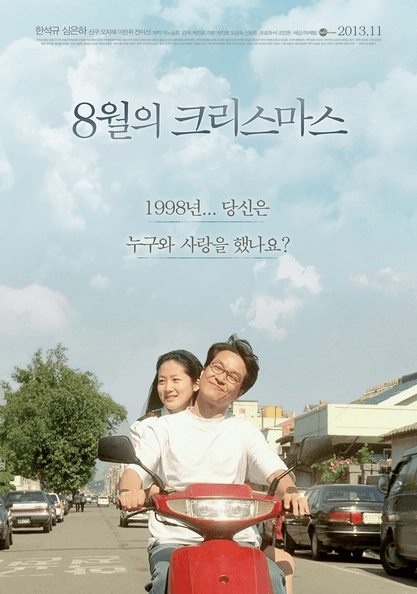
The Beauty of Saying Goodbye
Christmas in August (1998) explores love and death without a single dramatic outburst. This masterpiece remains one of the most beloved romantic dramas in the history of the Hallyu Roots. Directed by Hur Jin-ho, this film re-defined how Korean cinema portrays deep human emotion.
Christmas in August (1998) and the Post-IMF Melancholy
The year 1998 brought a time of deep reflection for South Korea.
- The IMF Aftermath: As the nation struggled with the economic crisis, audiences grew weary of loud, aggressive stories. They sought comfort in quiet, intimate narratives instead.
- A New Sensitivity: Christmas in August (1998) arrived during this transition. It offered a serene escape that resonated with a public looking for meaning in simple, everyday moments.
The Quiet Healing: Why 1998 South Korea Embraced the Stillness of Jung-won
To understand why Christmas in August (1998) became a cultural sanctuary, one must recall the “Economic Winter” of 1998. The IMF crisis had stripped many Koreans of their jobs, homes, and dignity. In a society screaming with financial agony, Director Hur Jin-ho offered a protagonist who faced the ultimate loss—death—with a calm smile.
He—the dying photographer Jung-won—rejects the polished spectacle of a tragic martyr. Instead, his daily life embraces the visual friction of mundane chores: teaching his father how to use a remote control or fixing a meal. This human-centered perspective ensures that the audience feels the staggering weight of their own resilience through his quiet acceptance. The film proves that cinematic honesty resides in the unpolished truth of a peaceful afternoon. By choosing to watch Jung-won live his final days without bitterness, a wounded nation found a healing path. It reminded them that even when the world is collapsing, the scent of a summer shower or the light in a photo studio remains a vibrant tribute to being alive.
The Plot of Christmas in August: A Love That Softly Fades
Jung-won (Han Suk-kyu) runs a small-town photo studio. He calmly accepts his terminal illness until he meets Da-rim (Shim Eun-ha), a spirited traffic officer. Their love never explodes into grand gestures. Instead, it unfolds through shared umbrellas, ice cream, and quiet conversations in his studio.
The Aesthetics of Stillness in Christmas in August (1998)
Director Hur Jin-ho intentionally broke the rules of traditional “Shinpa” (overly sentimental) melodramas.
- The Vision: Hur wanted to depict death as a natural cycle, much like the changing seasons. A smiling face in a funeral photo reportedly inspired his vision.
- The Strategy: He avoided hospital scenes and weeping families. Instead, he focused on “the aesthetics of stillness.” The camera lingers on mundane tasks like fixing a meal or developing photos, making the impending loss feel more grounded.
The Sanctuary of Memory: The Architecture of the Photo Studio in Christmas in August (1998)
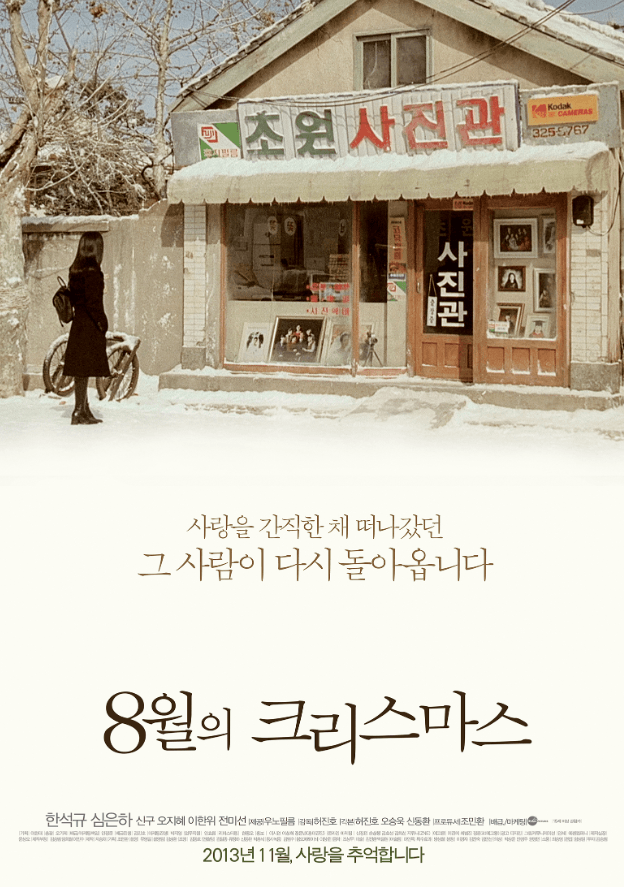
To master the spatial language of Christmas in August (1998), one must look closely at the “Chowon Photo Studio.” This small, humble space functions as more than just a place of business. It acts as a transitional zone between life and death. Director Hur Jin-ho utilized a sharp cinematic method to turn the dust-filled studio into a character of its own.
He—the dying Jung-won—rejects the polished spectacle of modern, fast-paced photography. Instead, his work embraces the visual friction of chemical developing tanks and manual focus lenses.
This human-centered perspective ensures that the audience feels the staggering slowness of his remaining days. In Christmas in August (1998), the studio represents the last stand of analog warmth in a rapidly digitalizing South Korea.
The scent of the darkroom and the soft click of the shutter provide a vibrant tribute to the moments we try to freeze in time. By centering the lens on this static location, the director proves that cinematic honesty resides in the unpolished truth of a quiet corner.
He remains the architect of a world where memory is the only thing that survives the winter.
Teaching the Remote Control in Christmas in August (1998)
One of the most heart-wrenching scenes in Christmas in August (1998) involves a simple television remote control. Jung-won (Han Suk-kyu) sits with his elderly father, patiently explaining how to operate the machine. This mundane task utilizes a sharp cinematic method to depict the terrifying reality of a son who knows he will die before his parent.
He—the dutiful son—rejects the polished spectacle of a dramatic deathbed confession. Instead, his love embraces the visual friction of a handwritten instruction sheet for the VCR.
This human-centered perspective ensures that the audience feels the staggering weight of a quiet, domestic sacrifice. In Christmas in August (1998), the remote control represents the “Digital Gap” that Jung-won tries to bridge before his departure.
The director proves that cinematic honesty resides in the unpolished truth of a son’s frustration and eventual patience. He establishes a healing path for those who worry about the loved ones they must leave behind.
By centering the lens on this fragile family bond, the film provides a vibrant tribute to the quiet intensity of filial piety.
The Intentional Restraint of Hur Jin-ho
Director Hur Jin-ho approached Christmas in August (1998) with the soul of an observer rather than a dramatist, employing a sharp cinematic method to remove the “artificial noise” typical of traditional melodrama.
By deliberately choosing what not to show, the film demonstrates that true intellectual sovereignty in filmmaking lies in restraint. Hospital hallways and medical machines are absent, allowing subtle, human-centered moments to emerge.
The narrative highlights the visual friction of dust motes dancing in the sunlight of the “Chowon Photo Studio,” ensuring that viewers sense the intellectual weight of mortality without being forced to weep.
The director’s vision was inspired by a funeral photo of a famous comedian, whose smiling face suggested that a “good goodbye” is possible. This dedication to grounded cinematic methods ensures that the “Hallyu Roots” of melodrama remain sophisticated and emotionally honest.
Every frame in Christmas in August (1998) serves as a social mirror, reflecting our shared longing for a graceful exit from life’s stage..
Changing the DNA of Korean Melodrama
Upon its release, Christmas in August (1998) acted as a revolutionary “breath of fresh air” for the industry. It marked a pivotal turning point by moving away from “Shinpa” (overly sentimental plots) toward a more refined, realistic storytelling style.
- The “Hur Jin-ho Style”: The film established a new sub-genre of “minimalist melodrama.” This “aesthetics of stillness” influenced future directors across Asia and proved that quiet films could achieve massive commercial success.
- Legendary Chemistry: Han Suk-kyu and Shim Eun-ha created a chemistry that no one has replicated since. This role solidified Han’s status as a top-tier actor and made Shim the “nation’s first love.”
- Global Prestige: According to the Korean Movie Database (KMDb), the film swept major awards, including Best Film at the Blue Dragon Film Awards. Its screening at the Cannes Film Festival also brought international recognition to the Hallyu Roots.
- Emotional Restraint: By avoiding dramatic hospital scenes or loud outbursts, the film found power in silence. This masterful restraint paved the way for the diverse and sophisticated landscape of modern Korean cinema.
The Sensory Connection of Da-rim and Jung-won
The chemistry in Christmas in August (1998) is not built on touch, but on “Auditory Minimalism” and shared spaces. Da-rim (Shim Eun-ha) represents the vibrant energy of a summer that Jung-won will never see again. Her presence utilizes a sharp cinematic method to highlight his fading time.
They—the star-crossed pair—reject the polished spectacle of grand confessions. Instead, their love embraces the visual friction of a letter pushed under a door or a stone thrown at a closed window.
This human-centered perspective ensures that the audience feels the staggering intensity of a love that never reached its full bloom. It establishes a healing path for viewers who have experienced “the one that got away.”
He—the director—proves that cinematic honesty resides in the unpolished truth of a silent gaze. By centering the lens on their subtle interactions, the film provides a vibrant tribute to the quiet intensity of human connection.
The scent of her perfume and the metallic chill of his studio’s gate become permanent memories in the viewer’s heart.
Auditory Minimalism in Christmas in August (1998)
One of the most profound reasons to watch Christmas in August (1998) is to experience its masterful use of sound. Director Hur Jin-ho utilizes auditory minimalism to highlight the things the characters cannot say. Instead of a loud, swelling orchestra, the film relies on the rhythmic sound of a ceiling fan, the distant hum of a motorbike, and the sudden downpour of a summer rain.
He rejects the polished spectacle of dramatic musical cues. Instead, the soundscape embraces the visual friction of silence itself. This approach ensures that the audience feels the intellectual weight of Jung-won’s internal world. When Da-rim leans against the studio window in Christmas in August (1998), the absence of dialogue creates a communal resonance with the viewer’s own unspoken longings. The director proves that a healing narrative requires the patience to listen to the gaps between words. He utilizes the sound of the wind through the trees to establish a path toward a peaceful ending. Every rustle of paper and every soft footstep in the studio acts as a vibrant tribute to the quiet intensity of existence.
Grooming for Death in Christmas in August (1998)
In Christmas in August (1998), the act of self-care becomes a sacred ritual. Jung-won continues to shave his face and wash his clothes even as his body fails him. He utilizes these repetitive actions to maintain his human dignity in the face of inevitable decay. Director Hur Jin-ho rejects the polished spectacle of a bedridden patient.
Instead, the narrative embraces the visual friction of a man carefully folding his laundry in his quiet room. This approach ensures that the audience feels the intellectual weight of a “composed goodbye.” When you watch Christmas in August (1998), you witness the scent of fresh soap and the sharp sound of a razor—sensory details that anchor the character to the present moment. The director proves that a healing narrative requires the courage to treat every morning as a gift. He utilizes the rhythm of these chores to establish a path toward a dignified end. Every frame of Jung-won’s grooming acts as a social mirror for our own desire to remain ourselves until the very last second.
Understanding Da-rim’s Grief in Christmas in August (1998)
To appreciate the emotional realism of Christmas in August (1998), one must analyze the scene where Da-rim throws a stone at the closed photo studio. This raw, unpolished moment represents the chaotic nature of young love and sudden loss. Da-rim—the spirited officer—rejects the polished spectacle of a dignified goodbye. Instead, her frustration embraces the visual friction of a locked door and an unanswered letter.
This human-centered perspective ensures that the audience feels the staggering confusion of a person left behind. In Christmas in August (1998), the stone is not just an object; it is a physical manifestation of her silent scream. He—the director—utilizes this sharp cinematic method to show that grief does not always look like tears. Sometimes, it looks like a shattered pane of glass. This commitment to grounded cinematic methods ensures that the “Hallyu Roots” remain relatable to anyone who has ever felt ignored by fate. The film proves that cinematic honesty resides in the unpolished truth of a messy, unfinished relationship. He provides a safe space for us to acknowledge that some stories end without a proper period.
How Christmas in August (1998) Re-wrote the Hallyu Roots
Before Christmas in August (1998), Korean melodrama was synonymous with “Shinpa”—a genre characterized by excessive wailing and impossible coincidences. Critics at the Blue Dragon Film Awards and the Cannes Film Festival were stunned by Hur Jin-ho’s “Auditory Minimalism.” He provided a communal resonance that relied on the intelligence of the audience rather than their tear ducts.
This approach allowed the film to spark a global dialogue about “Asian Minimalism.” It proves that intellectual sovereignty can coexist with massive commercial success. He—the director—provided a safe space for Korean cinema to mature. The technical sovereignty of the film’s pacing—slow, deliberate, and rhythmic—set the blueprint for future classics like One Fine Spring Day. Every scene in Christmas in August (1998) is layered with emotional resonance, demanding that the viewer appreciate the unpolished truth of a fading life. By learning from this masterpiece, future generations of directors learned that the loudest messages are often delivered in a whisper.
How Christmas in August (1998) Breathed Life into Asian Melodrama
The legacy of Christmas in August (1998) extends far beyond the borders of South Korea. After its release, the “Hur Jin-ho Style” became a benchmark for sophisticated storytelling across East Asia. He proves that intellectual sovereignty resides in the power of “Subtraction”—taking away the noise to reveal the soul.
Future directors, from the makers of Be With You to modern K-Drama writers, watch Christmas in August (1998) to study its “Atmospheric Stillness.” The technical sovereignty of the film’s color palette—warm yellows and faded greens—remains a vibrant tribute to the analog era.
He—the modern viewer—rejects the polished spectacle of loud, contemporary romances to find solace in this 1998 masterpiece. The film provides a safe space for historical reflection on how Hallyu transitioned from local sentimentality to global universality.
By choosing to watch this film legally, you honor the director who proved that a whisper can be louder than a scream. He remains a bridge between the analog heart of the 90s and the digital sophistication of modern cinema.
The Seasonal Transition: Why the Title Christmas in August (1998) Matters
The title Christmas in August (1998) offers a vibrant tribute to the paradox of human life. August represents the peak of vitality and heat, while Christmas symbolizes the cold stillness of winter and the end of the year. By bringing these two seasons together, Director Hur Jin-ho proves that intellectual sovereignty resides in the acceptance of opposites.
He rejects the polished spectacle of a linear timeline. Instead, the narrative embraces the visual friction of a life that ends in full bloom.
This human-centered perspective ensures that the audience feels the sobering realism of a “premature winter.” In Christmas in August (1998), the transition from the humid summer nights to the snowy funeral procession acts as a social mirror for our own mortality.
The director establishes a healing path by showing that even a short summer can contain the warmth of a lifetime. He—the modern viewer—remains a bridge between the vibrant colors of Da-rim’s uniform and the monochromatic peace of Jung-won’s final portrait.
By choosing to watch this seasonal shift, we honor the quiet intensity of every passing second.
Why We Return to the Photo Studio
In the end, Christmas in August (1998) is a meditation on the “Architecture of Memory.” It teaches us that while people pass away, the love they left behind becomes a fixed image, much like the photographs Jung-won develops. He—the modern viewer—rejects the polished spectacle of high-octane blockbusters to return to this quiet studio.
The film endures because it honors the person behind the patient. It reminds us that every life—no matter how short—is a vibrant tribute to the beauty of the ordinary. It gives viewers the rare gift of seeing death not as a tragedy, but as a “season” that must eventually turn. Even decades later, the unpolished truth of Jung-won’s smile in his own funeral photo remains a living inspiration. It provides a moral compass for anyone struggling with the brevity of life. He—the director—remains a bridge between the analog soul of 1990s filmmaking and the digital appreciation of today’s global audience.
Why Christmas in August (1998) Still Resonates
Even decades later, this film remains a pivotal turning point. It teaches us that the most profound emotions are often the quietest. For the readers of Dear, From K, Christmas in August (1998) serves as an essential archive to understand the refined roots of modern K-Drama.
f you enjoyed the emotional depth of Beat 1997, you’ll find a different kind of soul-searching in this 1998 classic.
Related Articles