
Bae Chang-ho: The Voice of 1980s Emotional Realism
If Im Kwon-taek represented historical depth, Bae Chang-ho embodied urban emotional realism. Emerging in the 1980s, Bae captured middle-class anxieties and shifting gender dynamics with unusual sensitivity. His films, especially Whale Hunting (1984), became a bridge between politically conscious cinema and the commercially ambitious 1990s.
The Plot of Whale Hunting (1984): Searching for Hope
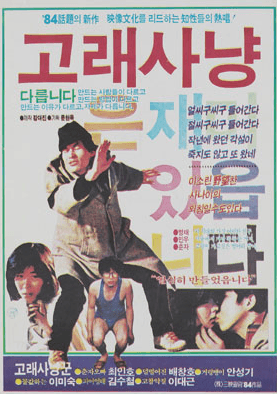
In 1984, Director Bae Chang-ho released a film that captured the frustrated heart of a generation. Whale Hunting (1984) follows Byeong-tae (Kim Su-cheol), a discouraged college student, and Min-woo (Ahn Sung-ki), a charismatic vagabond. Together, they journey to help a young woman find her hometown. In this film, the “whale” represents the elusive dreams and freedom that the 1980s generation desperately sought amidst political unrest.
Breaking the Silence: The Soul of Chun-ja in Whale Hunting (1984)
To master the emotional depth of Whale Hunting (1984), one must analyze the character of Chun-ja (Lee Mi-sook). Unlike typical female leads in 1980s melodramas, Chun-ja begins the film in literal silence. Having lost her voice due to trauma, she represents the “Muted Nation” under military rule. Director Bae Chang-ho utilized a sharp cinematic method to transform her disability into a powerful metaphor for repressed truth.
He rejects the polished spectacle of a tragic victim. Instead, the narrative embraces the visual friction of a woman regaining her identity through a journey of solidarity. This human-centered perspective ensures that the audience feels the staggering weight of her first spoken words at the end of the film. When you watch Whale Hunting (1984) today, you witness a silent battle for intellectual sovereignty. He—the director—proves that cinematic honesty resides in the unpolished truth of a healing voice. By centering the lens on Chun-ja’s internal awakening, the film provides a vibrant tribute to the resilience of the marginalized.
Whale Hunting (1984) and the “3S Policy” Era
The early 1980s in South Korea was a period of heavy censorship and social suppression under a military regime.
- The Search for an Escape: While the government promoted “3S Policy” (Screen, Sports, Sex) to distract the public, the youth felt a deep sense of existential void.
- A Voice for the Youth: Whale Hunting (1984) arrived as a rare cinematic vent. It channeled the suppressed energy of college students into a rebellious road trip, making it a cultural phenomenon that transcended the screen.
The Silent Scream of a Generation: Why the 1980s Needed Whale Hunting (1984)
To appreciate the staggering impact of Whale Hunting (1984), one must understand the “Metallic Chill” of the early 1980s in Seoul. The military government implemented the “3S Policy”—Screen, Sports, and Sex—to distract the public from political suppression. They encouraged the production of mindless erotic melodramas to numb the collective conscience of the youth.
Director Bae Chang-ho, however, rejected this polished spectacle of state-sanctioned distraction. He utilized Whale Hunting (1984) to offer something far more dangerous and beautiful: a sense of purpose. He proves that cinematic honesty requires the courage to reflect the existential void of a generation. In this masterpiece, the “Whale” functions as a vibrant tribute to the dreams that the government tried to erase. The audience feels the intellectual weight of the characters’ frustration because it mirrored their own reality. He—the director—established a healing path through the dusty roads of the Korean countryside, far away from the neon-lit traps of the city.
Why Whale Hunting (1984) Re-defined Korean Cinema
- Intimate Narrative: Unlike earlier melodramas, Bae’s storytelling feels observational. He focuses on urban loneliness and fragile masculinity.
- Naturalistic Style: Bae favors naturalistic performances. Even in a road movie format, the landscape serves as a psychological reflection of the characters.
- Cultural Impact: By normalizing emotionally complex male protagonists, Whale Hunting (1984) influenced later filmmakers exploring vulnerability.
Bae Chang-ho’s “Humanistic Realism”
Director Bae Chang-ho intended to create a “Commercial Art Film” that spoke directly to the masses.
- The Vision: Bae wanted to move away from the “Dark Realism” of the 70s. Instead, he chose a brighter, more dynamic “Road Movie” structure to portray the journey of growth.
- The Strategy: He used the “Whale” as a brilliant metaphor for something unattainable yet worth chasing. By casting a popular singer (Kim Su-cheol) alongside a veteran actor (Ahn Sung-ki), he successfully blended youthful energy with professional depth.
The Visual Friction of the Road: Bae Chang-ho’s Mastery in Whale Hunting (1984)
Bae Chang-ho approached filmmaking with the soul of a poet and the precision of a technician. In Whale Hunting (1984), the technical sovereignty of his “Road Movie” structure allows the characters to breathe outside the confines of social norms. He utilizes long takes and natural lighting to capture the raw, unpolished truth of the Korean landscape.
He rejects the polished spectacle of studio-bound dramas. Instead, he embraces the visual friction of winter winds and muddy paths. This human-centered perspective ensures that the audience feels the staggering physical toll of the characters’ journey. In Whale Hunting (1984), every frame vibrates with the scent of the earth and the sound of breaking waves. He proves that a healing narrative begins with the simple act of moving forward. His storytelling establishes a path through the internal struggle of Byeong-tae, transforming a clumsy student into a symbol of national awakening. By centering the lens on the vast, open sea, the director turns a local story into a universal epic of liberation.
The Frozen Horizon: The Symbolism of Winter in Whale Hunting (1984)
Why did Bae Chang-ho choose the harsh, gray landscape of winter for Whale Hunting (1984)? It is because the season itself functions as a psychological reflection of the characters’ isolation. In a world of warm, government-sponsored propaganda, the film returns to the sensory detail of the biting cold. This creates a communal resonance between the characters’ physical struggle and the viewer’s own social alienation.
This approach allowed Whale Hunting (1984) to spark a dialogue about the “Winter of the Soul” in South Korea. He—the director—utilized auditory minimalism to emphasize the sound of the wind and the crashing waves against the rocky shore. This human-centered perspective proves that a healing narrative begins with the courage to face the cold reality of one’s existence. The technical sovereignty of the cinematography captures the unpolished truth of a nation waiting for spring. Every frame of the winter sea in Whale Hunting (1984) is layered with emotional resonance, demanding that the audience look beyond the surface of a simple adventure.
A Collision of Icons: The Human Chemistry in Whale Hunting (1984)
The success of Whale Hunting (1984) relied heavily on its “Human-Centered Perspective” in casting. Director Bae Chang-ho took a massive risk by pairing the veteran actor Ahn Sung-ki with the popular rock singer Kim Su-cheol. This combination created a vibrant resonance that captured both the intellectual elite and the casual moviegoer.
Ahn Sung-ki, playing the vagabond Min-woo, utilizes a sharp cinematic method to portray a wise “Fool.” He rejects the polished spectacle of a traditional hero. Instead, his performance embraces the visual friction of a man who owns nothing but understands everything. Kim Su-cheol, as the awkward Byeong-tae, provides the heartbeat of the film. Together, they prove that intellectual sovereignty resides in the solidarity of the marginalized. Their chemistry ensured that the audience felt the emotional weight of their friendship. Whale Hunting (1984) remains a social mirror for the “Buddy Movie” genre because it prioritizes human connection over artificial plot twists. He—the director—remains the architect of this perfect balance between youthful energy and seasoned wisdom.
The Birth of a Blockbuster
Upon its release, Whale Hunting (1984) became an unprecedented “National Hit.”
- Box Office Sensation: The film attracted over 400,000 viewers in Seoul alone, making it the highest-grossing film of 1984. People lined up around the block to experience this sense of vicarious freedom.
- Critical Acclaim: Critics praised Bae for his “sophisticated visual sense” and his ability to bypass censorship while delivering a poignant social message. It won Best Film at the 20th Baeksang Arts Awards.
The Collective Breath: The Audience Reaction to Whale Hunting (1984)
To understand the cultural phenomenon of Whale Hunting (1984), one must look at the long lines outside the Piccadilly Theater in 1984. Millions of people, from factory workers to university students, flocked to see this film not just for entertainment, but for survival. They sought a vicarious escape from the suffocating pressure of urban life and political surveillance.
The film provided a safe space for the audience to laugh and cry together. He—the director—provided a communal resonance that transcended the screen. When Byeong-tae and Min-woo finally reached the sea in Whale Hunting (1984), the theaters often erupted in applause. This reaction proved that people were not passive viewers; they were stakeholders in the characters’ journey. This collective energy ensured that the film became a “National Hit,” proving that art can truly capture the fire of a real sacrifice for freedom. It remains a social mirror for a nation that often forgets the person behind the mass movement.
The Foundation of the “Buddy Movie”
The legacy of Whale Hunting (1984) echoes through the decades of the Hallyu Roots.
The Critical Awakening: How Whale Hunting (1984) Changed the Hallyu Roots
Why do modern critics still study Whale Hunting (1984) at the Korean Film Archive (KOFA)? It is because this film marked the end of the “Dark Realism” era. Throughout the 1970s, Korean films were often suffocatingly bleak. Bae Chang-ho, however, provided a communal resonance of hope. Critics from the 20th Baeksang Arts Awards praised the film for its “Auditory Minimalism” and its ability to bypass censorship through clever metaphors.
This approach allowed Whale Hunting (1984) to spark a national dialogue about the “Whale” in everyone’s heart. He provided a safe space for the audience to face their own repressed desires for freedom. This human-centered perspective proves that a successful blockbuster can also possess deep artistic sovereignty. The film provided the “DNA” for later masterpieces like The March of Fools and even modern road movies. Every scene in Whale Hunting (1984) is layered with emotional resonance, demanding that the viewer look beyond the surface level of a simple comedy. He transformed a commercial project into a site of profound ethical inquiry regarding the direction of a nation.
- Pioneering a Genre: It effectively established the “Buddy Movie” and “Road Movie” sub-genres in Korea. The chemistry between the clumsy student and the wise vagabond set the blueprint for countless future pairings.
- The “Bae Chang-ho Era”: This film solidified Bae Chang-ho’s position as the most influential director of the 1980s, proving that artistic integrity could coexist with massive commercial success.
Official trailer provided via YouTube. This official FHD trailer showcases the dynamic energy of 1980s Korean road movies. Watch closely for the chemistry between the legendary Ahn Sung-ki and singer-actor Kim Su-cheol, which defined a new era of performance.
The Eternal Journey: Why We Still Watch Whale Hunting (1984) Today
In the end, Whale Hunting (1984) is not just a relic of the 80s. It is a meditation on the human spirit’s refusal to stay quiet. Bae Chang-ho reminds us that every generation faces its own “Military Regime,” whether it is political, social, or internal. The film endures because it honors the person behind the protest. It reminds us that every historical change begins with a single, awkward step onto the road.
It gives viewers the rare gift of inhabiting a world where the sea is always waiting at the end of the journey. Even today, the vibrant energy of Min-woo and Byeong-tae in Whale Hunting (1984) remains a living inspiration. The film proves that even in a world of machines and censorship, the unpolished truth of a real dream can illuminate the darkest corners of a nation’s history. It provides a moral compass for anyone still searching for their own “Whale” in a cynical world. He—the director—remains a vibrant tribute to the quiet intensity of the human heart’s desire for freedom.
The Literary Foundation: From Page to Screen in Whale Hunting (1984)
The technical sovereignty of Whale Hunting (1984) resides in its strong literary roots. Based on the novel by Choi In-ho, the screenplay avoids the polished spectacle of traditional dialogue. Instead, the director utilized a sharp cinematic method to translate the internal monologues of the novel into visual poetry. He proves that intellectual sovereignty begins with the courage to deconstruct a myth.
In this masterpiece, the narrative evokes the sharp contrast between the intellectual ideal and the gritty reality of the road. By focusing on sensory details—the scent of old taverns and the metallic chill of a moving train—the director turned a popular novel into a site of profound ethical inquiry. Every scene in Whale Hunting (1984) is steeped in emotional resonance, demanding patience and attention from the viewer. He ensures that the audience feels the intellectual weight of the journey, making the film a vibrant tribute to the power of adaptation.
The Enduring Legacy of Bae Chang-ho
Whale Hunting (1984) remains a cultural touchstone because it perfectly balances commercial appeal with artistic integrity. During a time of strict censorship, Bae Chang-ho managed to speak to the hearts of the youth, offering them a metaphorical “whale” to chase. For those who want to dive deeper into the technical details and historical records of this era, the Korean Movie Database (KMDb) provides an extensive archive of Bae’s filmography.
Interestingly, the emotional realism and road-movie structure seen here laid the groundwork for future classics. If you enjoyed the poignant journey of Byeong-tae and Min-woo, you will certainly appreciate the quiet, reflective beauty found in our previous feature, Christmas in August (1998). Both films capture the essence of the Hallyu Roots by focusing on the subtle, human moments that define us all.
Related Articles
- 10 Best Korean Movies – Must-watch masterpieces of Korean cinema.
- Parasite Review – Hidden symbols and social commentary explained
- 90s Korean Movie Culture – The creative revolution that started Hallyu
- The Unique Storytelling Style of Korean Films: – 5 narrative techniques that define Korean cinema