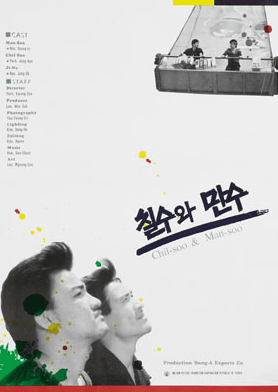
A Cry from the Neon Jungle
Parasite captivated the world with social commentary. However, a pivotal moment in 1988 changed Korean cinema first. As Seoul prepared for the global spotlight of the Summer Olympics, two young men climbed a massive billboard. They didn’t climb for glory, but out of desperation. Chilsu and Mansu (1988) is more than just a film; it is a raw, satirical archive of a nation’s soul in transition.
Chilsu and Mansu (1988) and the 1988 Paradox
In 1988, South Korea faced a deep paradox. The nation celebrated “Economic Miracles” while masking hidden struggles.
- The Olympic Glow vs. Urban Reality: While the government promoted a polished image for the Seoul Olympics, the working class remained invisible. Chilsu and Mansu (1988) reflects this hidden side of the neon signs.
- The Apgujeong Dream: Western capitalism flooded the country. Chilsu’s obsession with a fake American name reflects the frustration of a generation caught between tradition and Westernization.
- The Twilight of Censorship: This film was born at the end of strict government censorship. It was one of the first to bravely mirror the real political cries of the people.
Directorial Intent of Chilsu and Mansu (1988): Realism Over Melodrama
Director Park Kwang-su intended to break away from the “escapist” melodramas of the 1980s.
- The Vision: Park wanted to bring “New Realism” to Korean screens. He used the billboard as a metaphor for a society that looks grand from a distance but is hollow and dangerous up close.
- The Strategy: By choosing two billboard painters, he highlighted the people who “build” the city’s glamour but can never “own” it. He designed the climax not as a planned protest, but as a spontaneous explosion of human emotion.
The Plot: Two Men, One Forgotten Ladder
TThe story follows Chilsu and Mansu. Chilsu masks his anxiety with humor. Mansu is a weary painter. His father’s political past shadows his life.
As they paint ads for products they can never afford, their bond deepens. The climax atop the billboard is legendary—it wasn’t a calculated political protest, but a spontaneous explosion of human emotion from two men who felt they had no place on the ground.
Audience and Critical Reception of Chilsu and Mansu (1988)
The release of Chilsu and Mansu (1988) shocked both critics and the public.
- A New Wave: Critics hailed the film as the starting point of the “Korean New Wave.” They praised Park Kwang-su for his sophisticated visual language and sharp social critique.
- The Real-Life Confusion: During the filming of the rooftop scene, many citizens believed a real suicide attempt was occurring. They made emergency calls and gathered in large crowds. This proved how visceral and realistic the performance was for the 1988 audience.
Inside the Archive: Chilsu and Mansu Trivia
To truly appreciate this masterpiece, one must look at the fascinating stories behind the scenes:
- The “Real” Protest: During the rooftop scene filming, many citizens believed a real accident was occurring. They made emergency calls and gathered in crowds. This proved how visceral the performance was.
- The Birth of a Legendary Duo: This film marked the beginning of the iconic partnership between Ahn Sung-ki and Park Joong-hoon. They became the “De Niro and Pacino” of Korea. Later, they starred in hits like Two Cops and Radio Star.
- From Stage to Screen: Director Park Kwang-su adapted a popular stage play for this film. The original story came from a Taiwanese short story.
Historical Impact of Chilsu and Mansu (1988) on Modern K-Cinema
The legacy of Chilsu and Mansu (1988) lives on in today’s global hits.
- The Duo’s Legacy: This film marked the beginning of the iconic partnership between Ahn Sung-ki and Park Joong-hoon. They became the “De Niro and Pacino” of Korea, later starring in hits like Two Cops.
- The Foundation for Class Struggle Themes: Its focus on the “invisible class” laid the creative DNA for films like Parasite. It demonstrated that cinema could be a powerful mirror to society. For Dear, From K, this film is an essential starting point to understand the “Hip and Classy” roots of modern K-Cinema.
Why It Still Matters Today
Chilsu and Mansu (1988) remains a timeless masterpiece. As we archive this film at Dear, From K, we see that the struggles of the 80s provided the foundation for the storytelling we love today. It is not just a movie; it is a historical document of the Korean heart.
Explore More in Our Archive: > If you want to see how the realistic energy of the 80s evolved into the massive blockbuster era of K-cinema, check out our analysis of Shiri (1999).
Related Articles
- Green Fish (1997) – The Noir Beginning of Lee Chang-dong
- Christmas in August (1998) – The Quiet Masterpiece of Korean Melodrama
- A Single Spark (1995) – The Film That Defined Political Cinema
- 90s Korean Movie Culture – The Rise of Modern Korean Cinema
For detailed historical data and filmography, visit the Korean Movie Database (KMDB).