Why Green Fish 1997 Still Matters
In 1997, Green Fish 1997 quietly shifted the center of gravity of the South Korean film industry. A new cinematic language emerged—one rooted not in spectacle, but in memory, loss, and the fragile dignity of ordinary lives.
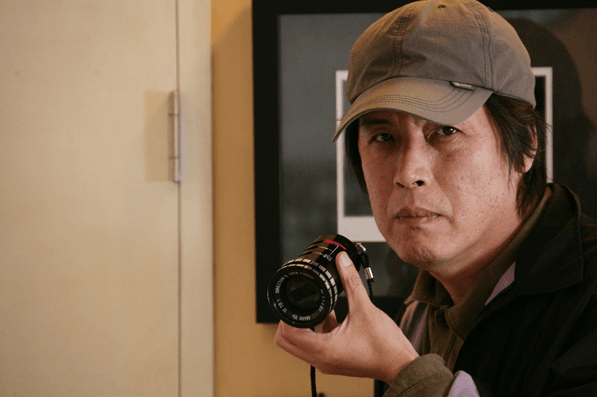
Lee Chang-dong, a novelist-turned-filmmaker, never intended Green Fish (1997) to be just another gangster film. Instead, he created something far more enduring: a vivid portrait of a nation in transition. The film serves as a quiet elegy for everything disappearing beneath the cold concrete. He utilized a grounded realism to capture the “Visual Friction” of a society losing its soul to industrialization. This approach ensures that the audience feels the “Sobering Realism” of the urban jungle.
Even today, Green Fish 1997 feels less like a period piece and more like a living memory—something that breathes, aches, and lingers long after the screen goes dark.
Green Fish 1997 and Ilsan: The New Town That Replaced Memory
To understand Green Fish 1997, you must first understand Ilsan in the 1990s. It was not just a location—it was a transformation.
The Korean government’s “New Town Project” turned fields, streams, and family homes into vast grids of apartment complexes. What was once rural became instantly urban. What was once personal became anonymous.
In Green Fish 1997, the film does not explain this transformation—it makes you feel it.
The protagonist, Mak-dong, returns from military service expecting familiarity. Instead, he finds disorientation. His home has disappeared. The past he cherished lies buried. The world he once knew now confronts him as a grid of identical buildings, each one erasing a piece of individuality.
The film does not shout this change. It lets it sit quietly in the background—like a memory that refuses to disappear.
And that is where its power begins.
Mak-dong in Green Fish 1997: A Man Without a Place
Mak-dong, portrayed by Han Suk-kyu, is one of the most quietly tragic characters in Korean cinema.
Ambition does not drive him. Intelligence is not his defining trait. Strength is not what sets him apart. Above all, he is simply human.
That is precisely why his story in Green Fish 1997 hurts so deeply.
He returns home with a simple desire—to belong, to help his family, to build something resembling a future. But the world he enters has no space for someone like him.
On a train, he meets Mi-ae, a woman tied to a gang led by Bae Tae-gon. That single encounter becomes the hinge of his life. What begins as curiosity slowly transforms into loyalty, and loyalty into entrapment.
Mak-dong does not choose crime out of greed. He drifts into it, almost gently, as if the city itself is guiding him toward an inevitable end.
And in Green Fish 1997, that inevitability is what makes everything feel so unbearably real.
Green Fish 1997 and the Collapse of Family Structure
One of the most devastating elements of Green Fish 1997 is not the violence—it is the absence of a stable family.
Mak-dong’s family exists, but it does not function. His older brother is disabled. His siblings are scattered. The home, though physically present, feels emotionally fractured.
In this vacuum, Mak-dong searches for something to replace what he has lost.
He finds it, tragically, in the figure of Bae Tae-gon—the gang boss who becomes a distorted version of a father.
But Green Fish 1997 never romanticizes this relationship. It exposes it.
The warmth Mak-dong seeks does not exist in the world around him; instead, authority and hierarchy take its place.
The sense of belonging he longs for turns into control.
What seems like family actually functions as a system built on obedience and fear.
And that confusion—between love and power—is where the film quietly breaks your heart.
The Dirty Noir of Green Fish 1997: A Different Kind of Crime Film
Unlike the stylized crime films of the 1990s, Green Fish 1997 rejects glamour entirely.
There are no heroic slow-motion shots. No polished violence. No seductive underworld.
Instead, Lee Chang-dong builds what can only be described as a “dirty noir.”
Clothes are wrinkled. Faces are tired. Violence is sudden and awkward.
Everything feels slightly off, slightly uncomfortable—like real life.
In Green Fish 1997, crime is not exciting. It is exhausting.
And that choice changes everything.
Because once the illusion of glamour is removed, all that remains is consequence.
Sound and Silence in Green Fish 1997: The Noise of a Changing World
Sound plays a subtle but devastating role in Green Fish 1997.
There is no overwhelming score guiding emotion. Instead, we hear the world itself:
- passing trains
- construction noise
- distant traffic
- the hum of a city that never stops building
These sounds are not background—they are pressure.
They remind us that the world is moving forward, whether individuals are ready or not.
In contrast, moments of silence feel almost sacred.
The most unforgettable example is the telephone booth scene.
Inside that small glass space, Mak-dong calls his brother. His voice breaks. There is no music to soften the moment. Just breathing, hesitation, and the unbearable weight of things left unsaid.
In that scene, Green Fish 1997 becomes something more than cinema.
It becomes memory.
The Symbolism of Green Fish 1997: A Memory That Cannot Survive
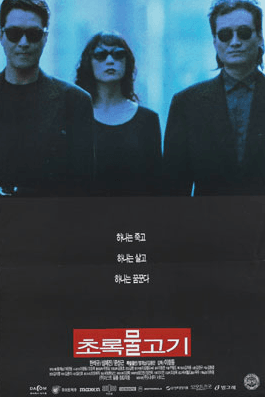
The title Green Fish 1997 carries one of the most haunting metaphors in Korean cinema.
Mak-dong recalls a childhood moment: catching a green fish in a clean stream with his family.
It is a simple memory. Almost insignificant.
But in the world of the film, it becomes everything.
The green fish represents:
- purity before industrialization
- connection before isolation
- family before fragmentation
In the city of concrete, that world no longer exists.
The stream is gone. The fish is gone.
All that remains is the memory.
And in Green Fish 1997, memory is both a refuge and a curse.
Cinematography in Green Fish 1997: The Power of Stillness
Lee Chang-dong’s background as a novelist is deeply felt in the visual language of Green Fish 1997.
The camera does not rush. It observes.
Long takes allow emotions to unfold naturally. Faces are not interrupted. Moments are not cut short.
This patience creates something rare:
The audience is not just watching Mak-dong.
We are sitting with him.
His silence becomes ours.
His confusion becomes ours.
And slowly, almost without noticing, his tragedy becomes ours as well.
The Final Image of Green Fish 1997: A Quiet Devastation
The final moments of Green Fish 1997 do not rely on spectacle.
They return, instead, to something deeply human: a shared meal, a family, a moment that feels almost normal.
But beneath that surface lies everything that has been lost.
The red willow tree stands as a silent witness.
It is not dramatic. It does not demand attention.
But it holds the weight of the entire film.
In that quiet space, Green Fish 1997 delivers its final truth:
Progress does not erase the past.
It buries it.
And sometimes, that burial is the deepest tragedy of all.
Green Fish 1997 in Context: A Nation Between Memory and Modernity
To truly understand Green Fish 1997, one must step outside the film and into the atmosphere of South Korea in the 1990s. This was not simply a decade of economic growth—it was a period of emotional dislocation.
The country was moving fast. Too fast, perhaps, for its own memory to keep up.
Entire neighborhoods disappeared almost overnight. Fields where families had lived for generations gave way to concrete grids. The language of progress—efficiency, expansion, modernization—spread everywhere, but beneath it, something quieter quietly erased the past.
IIn Green Fish 1997, the film never presents this erasure as a political argument. Instead, it lets us feel it.
Mak-dong does not stand in front of a demolished house and deliver a speech. He simply looks around, confused, as if trying to match his memories with what he sees. And the two do not align.
That gap—between what was and what is—becomes the emotional foundation of the film.
This is what makes Green Fish 1997 so deeply human. It does not explain change. It lets you feel the cost of it.
The Emotional Geography of Ilsan: More Than a Setting
Ilsan, in Green Fish 1997, is not just a backdrop. It is an emotional landscape.
The apartment complexes do not announce themselves as symbols. They simply rise, repetitive, impersonal, quietly oppressive. Windows reflect one another. Streets fold into sameness. No center exists, no orientation steadies you.
For Mak-dong, this creates a quiet but persistent anxiety. He has returned home, but he cannot locate it.
This experience is something many viewers—especially those who lived through rapid urbanization—recognize immediately.
Home is no longer a place. It becomes a memory.
And memories, unlike buildings, cannot be rebuilt.
Lee Chang-dong’s Literary Sensibility
Before becoming a filmmaker, Lee Chang-dong was a novelist. This fact is essential to understanding Green Fish 1997.
He does not construct scenes like a traditional director concerned with pacing or spectacle. Instead, he builds them like chapters in a novel—each moment layered with internal meaning, each pause carrying weight.
There is a kind of patience in his direction that feels almost radical today.
Lee Chang-dong lets silence breathe, without rushing to fill it. His characters pause, and we sit with their hesitation. The discomfort lingers, unresolved, drawing us deeper into their world.
This approach reflects a clear intention:
to respect the emotional intelligence of the audience.
Rather than telling viewers what to feel, Green Fish 1997 invites them to sit with uncertainty.
And in that uncertainty, something genuine emerges.
Why Green Fish 1997 Resonated So Deeply
When Green Fish 1997 was released, it did not rely on explosive marketing or spectacle. Yet it connected with audiences in a way that many louder films could not.
Part of this resonance came from recognition.
Viewers saw themselves in Mak-dong—not in his choices, but in his confusion. The feeling of returning to a place that no longer feels like home was, for many, painfully familiar.
The film also arrived at a moment when Korean audiences were becoming more open to introspective storytelling. After years of censorship and formulaic narratives, there was a hunger for something more honest.
Green Fish 1997 answered that hunger quietly, without announcing itself.
And that quietness became its strength.
The Beginning of a New Cinematic Language
Critics recognized immediately that Green Fish 1997 was different.
It was not just a well-made film—it was a shift in perspective.
Where previous films often emphasized plot, Green Fish 1997 emphasized experience. Where others sought resolution, it embraced ambiguity.
By focusing on lived experience rather than spectacle, Lee Chang-dong’s approach helped define the Korean New Wave—a movement that championed authenticity instead of sticking to one style.
Critics praised the film’s restraint, its emotional precision, and its refusal to conform to genre expectations.
Over time, it became clear that Green Fish 1997 was not simply part of this movement. It was one of its foundations.
From Local Story to Global Influence
Looking back, it is impossible to separate Green Fish 1997 from the global rise of Korean cinema.
When Bong Joon-ho and Park Chan-wook later took Korean cinema onto the world stage, they built on the emotional and thematic foundations that Green Fish 1997 had quietly laid years before.
Green Fish 1997 demonstrated that Korean stories did not need to imitate Hollywood to be powerful.
They could be local. Specific. Quiet.
And still resonate universally.
This realization changed everything.
It gave filmmakers permission to trust their own voices.
And that trust became the foundation of what the world now recognizes as Korean cinema.
Why This Film Still Feels Alive
There are films that age. And there are films that remain.
Green Fish 1997 belongs to the latter.
This is not because its themes are timeless in an abstract sense. It is because its emotions are immediate.
We feel left behind, yearning for somewhere we truly belong. Bit by bit, it hits us—something precious has already gone.
These emotions do not belong to any single decade—they are part of being human.
They are part of being human.
And that is why, even now, watching Green Fish 1997 does not feel like revisiting the past.
It feels like recognizing something in the present.
Helpful Content Reflection: Why Green Fish 1997 Matters Today
From the perspective of today’s viewers—and in the context of how we consume stories—Green Fish 1997 offers something increasingly rare: space.
The film creates space for thinking, feeling, and remembering.
In an era defined by speed, the film slows everything down.
It asks a simple but profound question:
What happens when progress moves faster than people?
And it does not answer that question directly.
It lets the viewer carry it.
That, perhaps, is the most valuable kind of storytelling.
Not the kind that concludes, but the kind that stays.
The Legacy of Green Fish 1997 in Korean Cinema
When audiences first watched Green Fish 1997, it did more than just win awards—it changed how people thought about Korean cinema.
It redefined what Korean cinema could be.
It proved that a film could be:
- socially critical
- emotionally intimate
- artistically restrained
- and still deeply powerful
It opened the path for filmmakers like Bong Joon-ho and Park Chan-wook, who would later bring Korean cinema to global recognition.
But before the international acclaim, before the Oscars, before the global spotlight—
There was Green Fish 1997.
Quiet. Unassuming. Devastating.
The Soul That Remains
At its core, Green Fish 1997 is not about crime.
It is not even about tragedy.
It is about longing.
A longing for something that once existed—
and can never return.
In a world reshaped by concrete and speed, the film reminds us of something fragile yet persistent:
It reminds us of our longing to return, the yearning to belong, and the instinct to hold on to memory.
And perhaps that is why Green Fish 1997 still matters today.
Because even now, in our own rapidly changing world,
we are all, in some way, still searching
for that green fish.
Discover More of Hallyu Roots While Green Fish 1997 explores the tragedy of an individual, our previous feature on A Single Spark 1995 examines the collective struggle for social justice. Both films are essential to understanding the evolution of 1990s Korean cinema.
Related Articles
- Beat (1997) – The Youth Icon of Korean Cinema
- Christmas in August (1998) – The Quiet Masterpiece of Korean Melodrama
- A Single Spark (1995) – The Film That Defined Political Cinema
- 90s Korean Movie Culture – The Rise of Modern Korean Cinema
For complete archival details, visit the Korean Movie Database (KMDb).