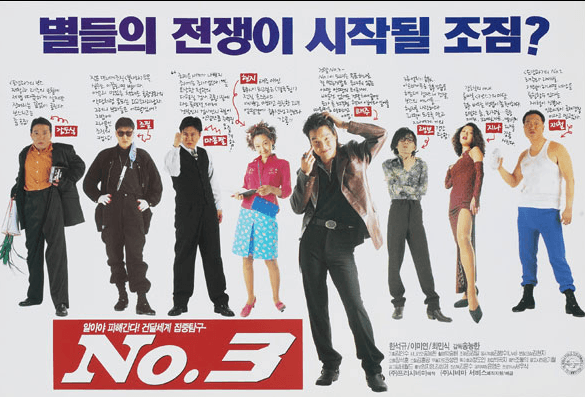
The King of 90s Korean Satire – No. 3 1997
In 1997, a film was released that completely redefined Korean comedy and noir. No. 3 1997 Korean Movie is a sharp-tongued masterpiece that mocks the absurdity of society through the eyes of third-rate gangsters. If you’ve only seen modern Korean cinema, this is the “vintage gold” you must discover on Dear, From K.
Before you laugh with No. 3, check out the tragic masterpiece we archived last time: The Beautiful Tragedy of Green Fish 1997.
No. 3 1997 and the “Number One” Obsession
The year 1997 was a year of extreme tension for South Korea, just before the IMF financial crisis.
- The Competition Trap: The nation was obsessed with becoming “Number 1” in every field. No. 3 (1997) brilliantly captures this social pressure where being “No. 3” is seen as a total failure.
- The End of an Era: It reflects a chaotic atmosphere where traditional values were collapsing, and a raw, materialistic survival-of-the-fittest mentality was taking over the streets of Seoul.
The Plot of No. 3 1997: Struggling to be Number 1
The story follows Tae-ju (Han Suk-kyu), a “No. 3” rank gangster who dreams of reaching the top. However, he is surrounded by idiots, hot-headed prosecutors (Choi Min-sik), and a bizarre rival named Jo-pil (Song Kang-ho). This film isn’t just about violence; it’s a brilliant parody of ambition and failure.
The Birth of a Cult Classic
Upon its release, No. 3 (1997) was an explosive success that shocked the industry.
- Critical Acclaim: Critics praised the film for its “unprecedented verbal wit” and stylistic boldness. It was hailed as a revolutionary work that moved away from the “slapstick” comedy prevalent in the early 90s.
- The Song Kang-ho Syndrome: While Han Suk-kyu was the main star, the audience was mesmerized by Song Kang-ho. His “Hungry Spirit” speech became a national meme. The film attracted over 290,000 viewers in Seoul, a massive hit for a R-rated satire at the time.
No. 3 1997 as a Social Parody
Director Song Neung-han intended to create a “Subversive Satire” that ridiculed all authorities.
- The Vision: He wanted to strip away the “glamour” of gangster life often shown in Hong Kong noir. Instead, he portrayed gangsters as pathetic, talkative, and insecure men.
- The Strategy: By using fast-paced dialogue and “manic” energy, the director mocked the hypocrisy of intellectuals, the law, and organized crime alike. He designed No. 3 (1997) to show that in a broken society, everyone is essentially a “third-rate” player.
No. 3 1997 and the “Holy Trinity”
The legacy of No. 3 (1997) changed the landscape of Korean cinema forever.
- The Big 3 Gathering: It is the rare treasure that captured Han Suk-kyu, Choi Min-sik, and Song Kang-ho in their raw youth. This trio would later become the “Holy Trinity” of the Hallyu wave.
- Paving the Way for K-Noir: The film’s unique blend of humor and violence laid the foundation for future “Gangster-Comedies” and sophisticated K-Noirs. It proved that a movie could be intellectually sharp while being commercially successful.
Hilarious Facts and Legends
- The “Hungry Spirit” Improv : The most famous scene in the movie—the “Hungry Spirit” (헝그리 정신) speech in the mountain—was largely the result of Song Kang-ho’s genius. It is said that the script was simple, but Song’s stuttering delivery and intense focus were so realistic that the staff had to hold back their laughter to avoid ruining the take. This one scene turned an unknown actor into a national superstar.
- The “Big 3” Gathering: It’s almost impossible to see these three together now: Han Suk-kyu, Choi Min-sik, and Song Kang-ho. At the time, they were rising stars, but today they are the “Holy Trinity” of Korean cinema. No. 3 1997 is the rare treasure that captured them all in their raw, energetic youth.
- Real Gangsters were Offended? There’s a famous rumor that actual organized crime members were offended by how “stupid” the film made them look. However, the public loved it, as it stripped away the “glamour” of gangster life and showed it as something pathetic and funny.
Why This Film is a Must-Watch for Korean Culture Fans
Beyond the laughs, No. 3 1997 reflects the chaotic social atmosphere of Korea just before the 1997 financial crisis. It shows a world where everyone is desperately fighting to be “No. 1” but only ends up being a “No. 3.”
Related Articles
- Green Fish (1997) – The Noir Beginning of Lee Chang-dong
- Christmas in August (1998) – The Quiet Masterpiece of Korean Melodrama
- A Single Spark (1995) – The Film That Defined Political Cinema
- 90s Korean Movie Culture – The Rise of Modern Korean Cinema
Check out the full cast and trivia on the No. 3 (1997) KMDb page