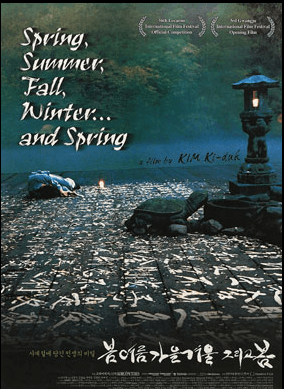
Exploring the profound Buddhist Philosophy behind Kim Ki-duk’s masterpiece, Spring, Summer, Fall, Winter… and Spring (2003), reveals a story that stays with you forever—quietly, almost like a memory you didn’t know you had.
Directed by the visionary Kim Ki-duk, this story doesn’t rush. It doesn’t rely on loud speeches or fast action. Instead, it invites you to sit by a quiet lake and watch as a life unfolds. This is more than a movie; it is a profound meditation on Buddhist Philosophy that speaks to the soul through silence and the changing seasons.
1. A Story That Moves Like the Seasons
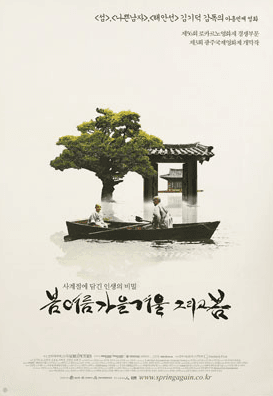
At first glance, the premise is simple. A boy grows up in a small floating temple on Jusanji Reservoir, guided by an old master. But as we watch him leave, struggle, and eventually return, we realize this isn’t just a story about a monk. It’s a mirror held up to our own lives.
In Buddhist Philosophy, life is not a straight line leading to a destination. It is a circle—a cycle of desire, regret, learning, and starting over.
Spring: The Weight of Innocence – A child ties stones to animals out of curiosity. He doesn’t mean any harm, but the master teaches him a haunting lesson: even our thoughtless actions become a weight we must eventually carry in our hearts. This is the quiet beginning of Karma.
Summer: The Turbulence of Desire – As adolescence arrives, a young woman visits the temple. With her comes a restlessness. We see how easily peace can be broken when attachment takes root.
Fall: Remorse and the Concept of Jeong (정) – The monk returns as a man carrying heavy guilt. Here, we see Jeong—that deep, often painful bond formed through shared suffering and the long road to forgiveness.
Winter: The Path to Redemption – Against a frozen, silent landscape, there is nowhere left to run. No distractions, no excuses. Only the self. It reminds us that enlightenment is a transformation earned through the fire (or ice) of self-confrontation.
Spring Again: The Eternal Return – A new child arrives. The temple remains. The lessons will be learned again. It’s a beautiful, bittersweet reminder that life is an endless circle of renewal.
What Does This Film Really Mean?
At its core, Spring, Summer, Fall, Winter… and Spring is about the cyclical nature of human life.
Rather than telling a conventional story, the film reflects a key idea in Buddhist philosophy: life is not a straight path, but a continuous cycle of desire, suffering, reflection, and renewal.
Each season represents a stage of life—innocence, passion, consequence, and transformation.
This is why the film feels so personal. It doesn’t just tell a story; it reflects a pattern we all go through.
2. Jusanji Reservoir: The Landscape of Buddhist Philosophy
The mystical atmosphere of the film isn’t a special effect—it’s a real place in South Korea. Jusanji Reservoir, located in Cheongsong, is a site where time seems to stand still. Built in 1720, this lake is famous for its centuries-old willow trees that grow directly out of the water.
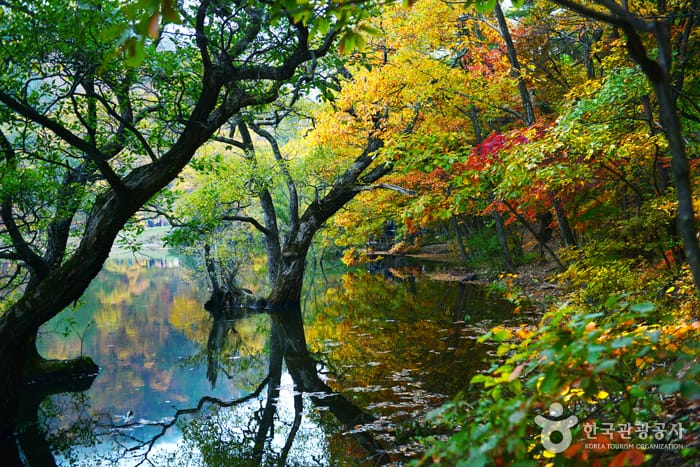
The weathered trunks of these trees, submerged yet reaching for the sky, serve as a powerful metaphor for human existence—rooted in suffering, yet striving for something higher. While the floating temple set is gone today, its absence perfectly reflects the film’s message of Impermanence (Anicca): all things are fleeting, and eventually, we all return to nature.
📍 Visiting Jusanji Reservoir
- Address: Jusanji-ri, Cheongsong-gun, Gyeongsangbuk-do (경상북도 청송군 주왕산면 주산지리)
- Inquiries: +82-54-870-6111 / 1330 Travel Hotline
- Pro-tip: Visit in the early morning to see the mist on the water, just as it appeared in the film.
3. The Global Impact of Korean Buddhist Philosophy
Upon its release, the film was a massive critical success, winning the Grand Prix at the Locarno International Film Festival and maintaining a high score on Rotten Tomatoes. But its true legacy isn’t in awards.
It matters because it reminds us to slow down. In a world of constant noise, Kim Ki-duk used silence to prove that the most profound emotions—guilt, love, and enlightenment—don’t need words. It is a “visual sermon” that reconnects us with the timeless serenity found in the Korean soul.
Final Thoughts: Which Season Are You In?
More than twenty years later, Spring, Summer, Fall, Winter… and Spring remains a timeless classic. It doesn’t tell you what to think; it simply shows you the water moving and the wind passing, and leaves the rest to you.
It reminds us that while life is filled with mistakes, it is also defined by the constant, quiet possibility of starting again.
So, I want to ask you: Which season of life do you feel you are in right now? Are you in the restless, warm Summer of desire, or perhaps the quiet, reflective Winter of your journey?
Let’s share our stories in the comments below. I’d love to hear your thoughts.
Related Articles
You may also enjoy:
- The Meaning of Jeong in Korean Culture: The Invisible Heart of Korea
- How to Visit Cheongnyeongpo: 5 Heartbreakingly Beautiful Tips
- The Wailing Ending Explained: 7 Surprising Secrets You Never Knew
Sources & Further Reading: